If your business doesn’t appear when someone asks ChatGPT about your industry, you’re invisible to millions of potential customers. ChatGPT now handles 2.5 billion queries per day and has 900 million weekly active users (DemandSage, 2026). Most of those users aren’t clicking through to a search results page. They’re reading AI-generated answers — and acting on what gets cited.
Most businesses want to get their brand into AI answers but have no idea where to start. That’s what this guide fixes. You’ll get the exact technical steps, content strategy, and authority-building moves that determine whether ChatGPT cites your business or your competitor’s.
TL;DR: Getting cited by ChatGPT requires three things done in order — technical access (allow AI crawlers, get indexed by Bing, add schema markup), citation-worthy content (factual, structured, FAQ-driven), and off-site authority (reviews, directories, Reddit presence). AI-referred traffic grew 527% in early 2025 (Search Engine Land, 2025) — the businesses acting now will own that traffic.
What Is GEO, and Why Does It Matter Right Now?
Generative Engine Optimization (GEO) is the practice of optimizing your online presence so AI models cite your business in their responses. AI-referred visits to transactional sites reached 1.1 billion in June 2025 — a 357% year-over-year increase (Similarweb, 2025). Early movers are capturing that traffic now. Latecomers will be competing against entrenched brands that AI already trusts.
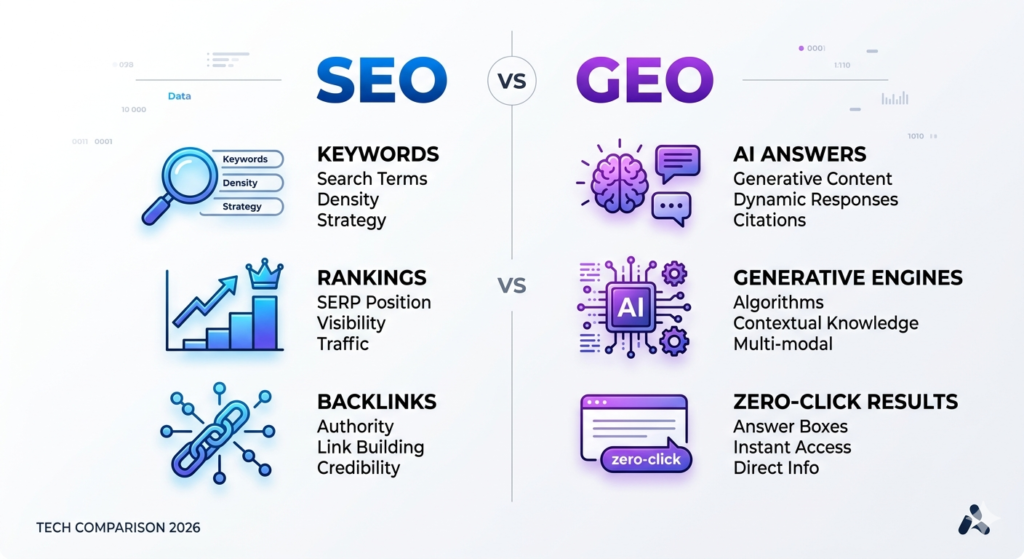
SEO and GEO share the same goal — visibility — but the mechanics are completely different:
| Traditional SEO | GEO | |
|---|---|---|
| Goal | Rank #1 on Google | Be cited in AI response |
| Output | 10 links on SERP | 2–7 cited sources per answer |
| Key Signal | Backlinks + keywords | Authority + structure + trust |
| Measure | Rankings + traffic | Share of Model (SoM) |
The GEO services market was valued at $886M in 2024 and is projected to reach $7.3B by 2031 (Valuates Reports, 2025). That growth signals one thing: the businesses building GEO strategies now won’t just appear in AI answers — they’ll become the default reference point in their category.
Technical Setup: Make AI Crawlers Welcome
ChatGPT can’t cite what it can’t access. According to Search Engine Land (2025), ChatGPT’s real-time search runs on Bing’s index — not Google’s. If Bing hasn’t crawled you, or if your site blocks AI bots, you don’t exist in ChatGPT’s world. These four technical fixes take less than an hour and unlock AI crawler access entirely.
Fix Your robots.txt
The most common mistake is no explicit allow rule for AI bots. Some server configurations default to blocking unfamiliar user agents. Add these lines to your robots.txt:
User-agent: GPTBot
Disallow:

User-agent: OAI-SearchBot
Disallow:

User-agent: PerplexityBot
Disallow:

User-agent: ClaudeBot
Disallow:
A blank Disallow: means “allow everything.” Without these entries, you may be invisible to every major AI crawler.
Submit to Bing Webmaster Tools
If Bing hasn’t indexed your site, ChatGPT’s browsing feature can’t find you — full stop. Fix it in 10 minutes: create a Bing Webmaster Tools account, submit your XML sitemap, and verify ownership via DNS or HTML meta tag. Then check the coverage report for crawl errors and fix any blocked pages.
Add Schema Markup
Three schema types drive the highest AI citation rates for local businesses:
- LocalBusiness — name, address, phone, hours (essential for local AI discovery)
- FAQPage — structured question/answer pairs that AI can extract verbatim
- Article — for all blog content, with author credentials and publication date
Microsoft’s Bing confirmed in 2025 that schema markup directly helps LLMs understand content for AI answers (Digital Information World, 2025). Pages with FAQPage schema achieve citation rates nearly three times higher than equivalent pages without it.
Add an llms.txt File
Since 2024, placing a plain-text file at yoursite.com/llms.txt has become a recognized best practice. It gives AI models a structured, plain-language summary of your site — who you are, what you do, and your key pages. Think of it as a sitemap written for AI rather than for search engine crawlers.
How to Write Content That AI Quotes
9:41ChatGPTBest plumber near me?Based on verified reviews,AcmePlumbing.comis rated 4.9★ locally.AI surfaces yourbusiness directlyin answersContent structure determineswhether AI cites you or skips you.900M weeklyactive users67.7% longeron-site time vsorganic visitors
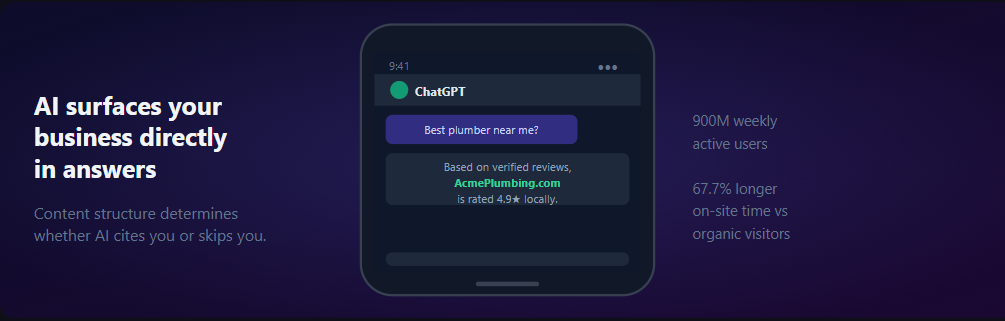
Content structure determines whether AI cites you or skips you entirely. Adding quotations to your content increases AI visibility by 37%, and adding statistics boosts it by 22%, according to a Princeton GEO study analyzing 10,000 queries (KDD 2024). These aren’t marginal improvements — they’re the gap between showing up and not existing in AI responses.Content Format Impact on AI Citation RateFAQPage schema41% cite rateAdding quotations+37% visibilityComparative listicles32.5% of citationsAdding statistics+22% visibilitySources: Princeton GEO Study (KDD 2024) · The Digital Bloom citation report, 2025 · Relixir/Averi.ai, 2025Content elements that most improve AI citation rates. Source: Princeton GEO Study (KDD 2024) + The Digital Bloom, 2025.
Use Declarative, Factual Language
AI models cite facts. They don’t cite opinions. Every claim on your site should be verifiable and specific.
“We think our service is great.”
“Rated 4.8/5 across 2,000+ verified reviews on G2.”
The second version is quotable. The first is not. Go through your homepage, service pages, and about page. Anywhere you find vague language, replace it with a specific, sourced claim.
Structure for AI Parsing
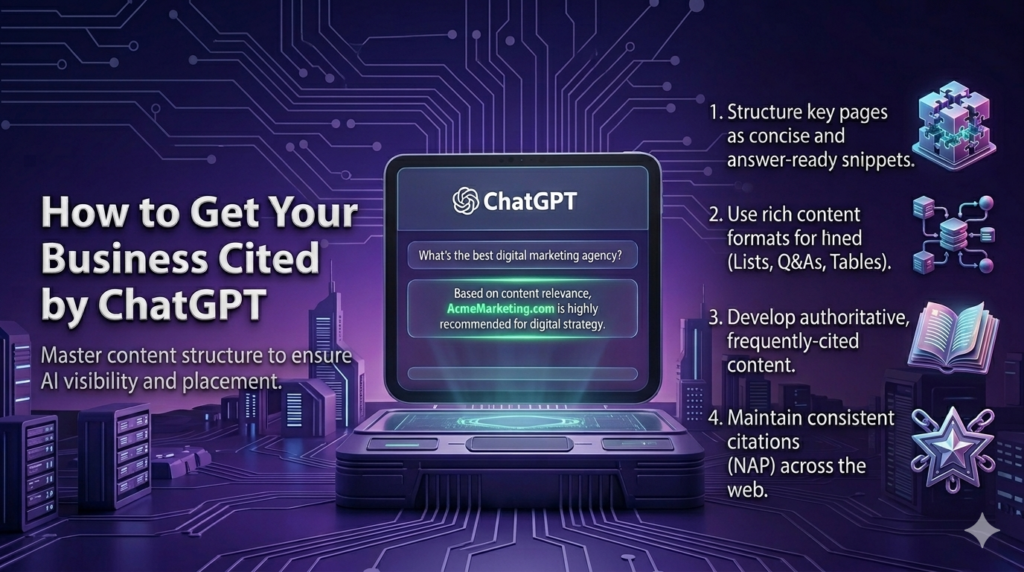
Put the answer first, context second. Use H2 and H3 headings that match real search queries — not creative marketing copy. Keep paragraphs to 2–3 sentences maximum. Use numbered steps, bullet lists, and comparison tables wherever the content allows it.
Our observation at CentNine: Comparative listicles capture 32.5% of all AI citations — more than any other content format — according to The Digital Bloom’s analysis of 7,000+ AI citations (The Digital Bloom, 2025). For US local businesses, this means “best [service] in [city]” articles are disproportionately powerful for appearing in ChatGPT results. It’s the highest-ROI content type we’ve found for local AI visibility.
Build a Dedicated FAQ Page
Each FAQ entry should follow a strict structure: one real question, answered in 2–3 direct sentences. No intro fluff. No preamble. Answer immediately. Source your questions from Google’s “People Also Ask,” relevant Reddit threads, and AnswerThePublic. These are the exact queries your customers are already asking AI.
Content Types That Earn Brand Mentions in AI Answers
AI strongly prefers citing primary sources over secondary commentary. The highest-performing content types for earning AI citations are:
- Original research and surveys — Ask your customers something meaningful and publish the results. Example: “2025 Local Business GEO Report.”
- Case studies with hard numbers — Example: “43% reduction in customer churn after switching to X.”
- Comparative listicles — “Best [service] providers in [city]” format earns citations at a 32.5% rate
- FAQ-structured pages — Built explicitly for AI extraction with FAQPage schema
Show E-E-A-T Signals Clearly
Include author bios with real credentials on every article. Display publish dates and last-updated dates visibly. Reference external authoritative sources throughout your content. List certifications, awards, and industry partnerships on your about page. Google’s Quality Rater Guidelines state: “Trust is the most important member of the E-E-A-T family” — AI models appear to apply the same standard when selecting sources.
Authority Building: Get Talked About Everywhere
GoogleBusinessYelpReviewsBBBListingRedditThreadsG2ReviewsClutchProfileLinkedInCompanyCapterraListingYOURBRANDcited by AI
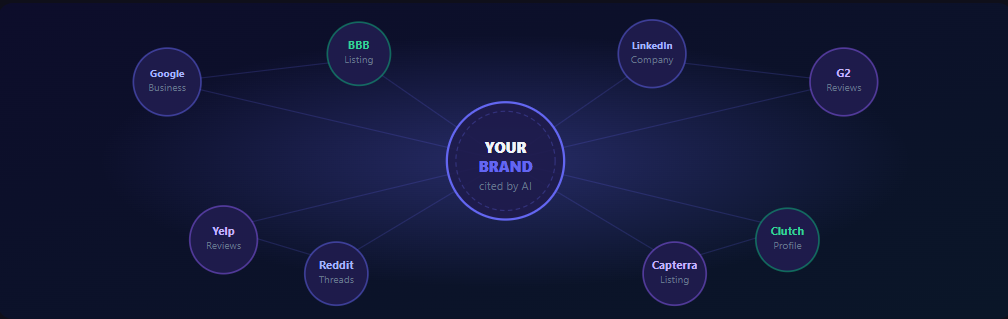
Wikipedia appears in 47.9% of ChatGPT’s top-10 most-cited sources, based on analysis of 680 million citations (Profound, 2025). You don’t need a Wikipedia page. But you do need to replicate what makes Wikipedia citable: consistent, factual, cross-linked information that appears across multiple authoritative sources.
Get Listed on High-Authority Platforms
Third-party mentions signal trust to AI models in a way your own site can’t. Prioritize by business type:
- B2B and professional services: G2, Capterra, Clutch, Gartner Peer Insights, Crunchbase
- B2C and local businesses: Google Business Profile, Trustpilot, Yelp, BBB (Better Business Bureau)
- All businesses: LinkedIn company page, local chamber of commerce listings, industry directories
What we’ve seen with US local businesses: Google Business Profile reviews, combined with consistent Yelp and BBB listings, create enough cross-platform authority for ChatGPT to reference a local business by name when asked about services in a specific city. This is how to make your brand visible in AI chats without publishing a single new article — the directory presence alone can trigger AI citations.
Use Reddit Strategically
Reddit is the most-cited domain in AI-generated answers overall, ahead of YouTube and LinkedIn (Peec AI, via Search Engine Land, 2025). ChatGPT Search cites Reddit in 13% of its responses (Semrush, 2025, analysis of 248K Reddit URLs). Participate in subreddits where your customers ask questions. Answer genuinely. No self-promotion. Build a reputation in your niche first — when those threads appear in AI answers, your brand appears with them.
Maintain Brand Consistency Across All Platforms
Use the same business name, description, and tagline everywhere. NAP consistency (Name, Address, Phone) matters for local AI citations the same way it matters for local SEO. Conflicting information — different phone numbers, varying business names, inconsistent descriptions — creates ambiguity that AI models resolve by skipping your brand entirely.
How to Track ChatGPT Brand Mentions and Know It’s Working
Knowing how to track ChatGPT brand mentions is what separates businesses that optimize blindly from those that improve systematically. ChatGPT drives 77.97% of all AI referral traffic, and visitors from AI tools spend 67.7% more time on site than organic search visitors (SE Ranking, 2025, 63,987 websites). This traffic converts better — it’s worth measuring precisely.AI Referral Traffic Share by Platform (2025)ChatGPT77.97%Perplexity15.10%Gemini6.40%Others0.53%Source: SE Ranking study, 63,987 websites across 250 countries, Jan–Apr 2025ChatGPT accounts for nearly 78% of all AI referral traffic — making it the primary platform to optimize for. Source: SE Ranking, 2025.
Key Metrics to Monitor
| Metric | What It Tracks | How to Measure |
|---|---|---|
| Share of Model (SoM) | Brand appears in AI answers | Promptmonitor, Profound |
| Citation Rate | Direct brand citations | Manual testing |
| AI-Referred Traffic | Visits arriving from AI tools | GA4 source/medium report |
| Brand Sentiment | Tone of AI mentions | Prompt auditing log |
Manual Method: Track Brand Performance in ChatGPT Over Time
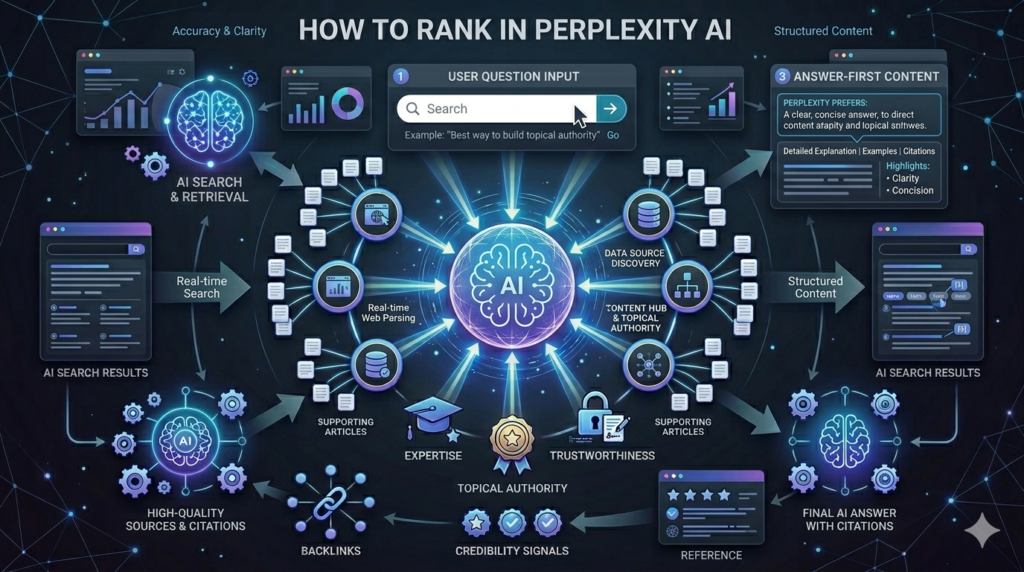
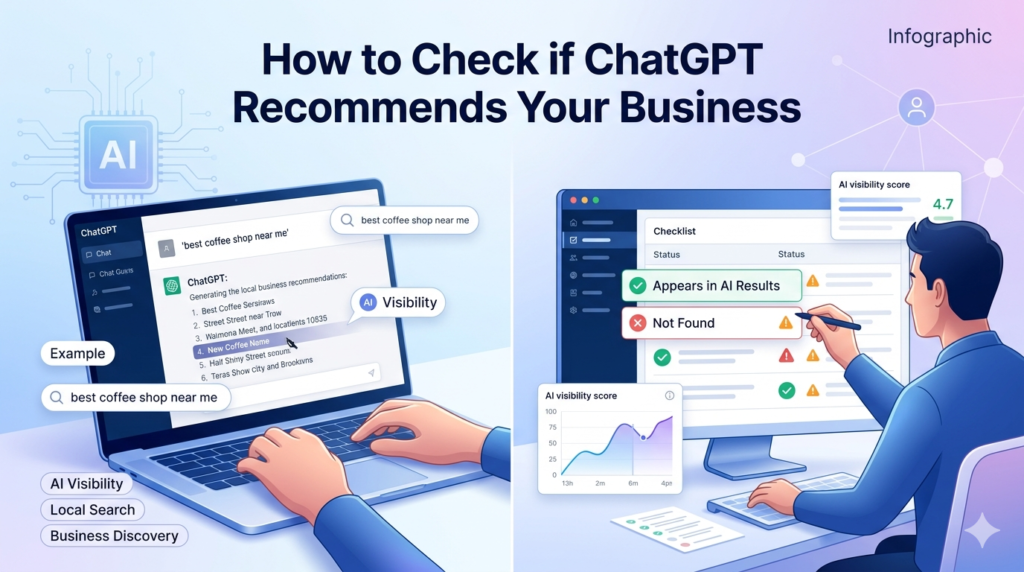
Build a query bank of 20–30 questions your customers ask AI about your industry and services. Test weekly across ChatGPT, Perplexity, and Gemini. Log each test in a spreadsheet:
| Date | Platform | Query | Brand Appeared? | Competitor Cited? |
|---|---|---|---|---|
| (Log your weekly tests here) | ||||
Track trends over 90 days. This is how to track brand performance in ChatGPT responses over time without any paid tooling — and it reveals exactly which content gaps are costing you citations.
Paid Tools for Monitoring Brand Mentions in ChatGPT (USA)
For US businesses that want automated monitoring at scale:
- Profound.ai — Deep citation analytics; their research database covers 680M+ AI citations
- Otterly.ai — Tracks brand mentions across ChatGPT, Perplexity, Gemini, and Copilot
- Promptmonitor.ai — Share of Model tracking with competitor benchmarking built in
- Peec AI — AI share of voice with citation source breakdown by platform
7 Mistakes That Keep Businesses Out of ChatGPT Answers
| ❌ Mistake | ✅ Fix |
|---|---|
| Stats without sources | Always cite a named primary source |
| Answer buried mid-article | Put the direct answer in your first paragraph |
| Only own site optimized | Build third-party directory and review presence |
| Ignoring Bing indexing | Submit your sitemap to Bing Webmaster Tools |
| Vague language (“best in class”) | Replace with verifiable, specific facts |
| One platform focus | Optimize for ChatGPT, Perplexity, and Gemini simultaneously |
| Expecting fast results | Budget 3–6 months for measurable Share of Model gains |
Frequently Asked Questions
How long does it take to get cited by ChatGPT?
Most businesses see measurable Share of Model improvements within 3–6 months of consistent GEO work. Technical fixes — robots.txt, Bing indexing, schema markup — can have faster impact once AI crawlers re-index your site. Content authority compounds over a longer period. Track monthly and compare against a 90-day baseline.
Is GEO different for local US businesses?
Yes, significantly. Local businesses need to prioritize NAP consistency, Google Business Profile optimization, and local directory listings first. These create the cross-platform authority signals AI models use to recommend local services by name. ChatGPT will reference a local business directly when enough consistent third-party data exists across Google, Yelp, and BBB.
Does traditional SEO still matter if I’m doing GEO?
Both matter, and they reinforce each other. ChatGPT’s browsing uses Bing’s index — not Google’s — so Bing rankings are your immediate priority for real-time AI citations. But strong content that ranks well on Google frequently earns AI citations too. Run both in parallel rather than treating them as competing priorities.
What’s Share of Model (SoM)?
Share of Model is the percentage of AI-generated answers where your brand appears, measured across a defined set of queries in your category. It’s the GEO equivalent of market share — the primary metric for tracking how to improve brand visibility in AI search engines over time. Tools like Profound and Otterly calculate this automatically.
Do I need a Wikipedia page to get cited by ChatGPT?
No. Wikipedia’s dominance in AI citations comes from its consistent factual structure, cross-linking, and multi-source verification — not from being Wikipedia. Replicating those trust signals through consistent directory listings, authoritative content, and third-party reviews achieves the same effect for a business.
The Window Is Open — But It Won’t Stay That Way
Every week without a GEO strategy is a week your competitors gain ground in AI answers. Start with the technical foundation: fix your robots.txt, submit to Bing, add schema markup. Then publish one piece of citation-worthy content. Then get listed on three high-authority platforms.
That’s the sequence. It’s repeatable, and it works.